
- What makes a matrimonial website safe?
- 7 signs you have found a safer matrimonial website
- How do you check whether a matrimonial profile is genuine?
- What are the biggest red flags on a matrimonial website?
- Is it safe to share your phone number on a matrimonial website?
- How can families use a safe matrimonial website?
- Safe matrimonial website checklist
- What should you do if you suspect a matrimonial scam?
- FAQs about safe matrimonial websites
- The safest way to use a matrimonial website
- Not sure where to start?
A safe matrimonial website should do more than display marriage profiles. It should give you reasonable control over your personal information, provide ways to identify or report suspicious accounts, and make it harder for strangers to misuse the platform.
But there is another side to safety that people sometimes miss: you still have to verify the person behind the profile.
That is especially important when a rishta search moves online. A professional-looking profile is not proof of character, identity, marital status, financial position, or family background.
For families and individuals searching for a serious marriage proposal, the safest approach is to evaluate both the website and the person.
What makes a matrimonial website safe?
A safe matrimonial website should have visible, understandable safety practices rather than vague promises about being “trusted.”
Look for evidence of:
- Profile or identity verification
- Privacy controls
- Secure communication
- A clear reporting and blocking process
- Transparent terms and privacy information
- Active customer support
- A serious approach to marriage rather than casual interaction
- Clear guidance about suspicious profiles and financial scams
Some Pakistani matrimonial platforms publicly describe measures such as manual verification, restricted access to contact details, privacy controls, or family involvement. Those are useful features, but you should still understand exactly what each platform means by “verified.”
That word gets used very loosely online.
7 signs you have found a safer matrimonial website
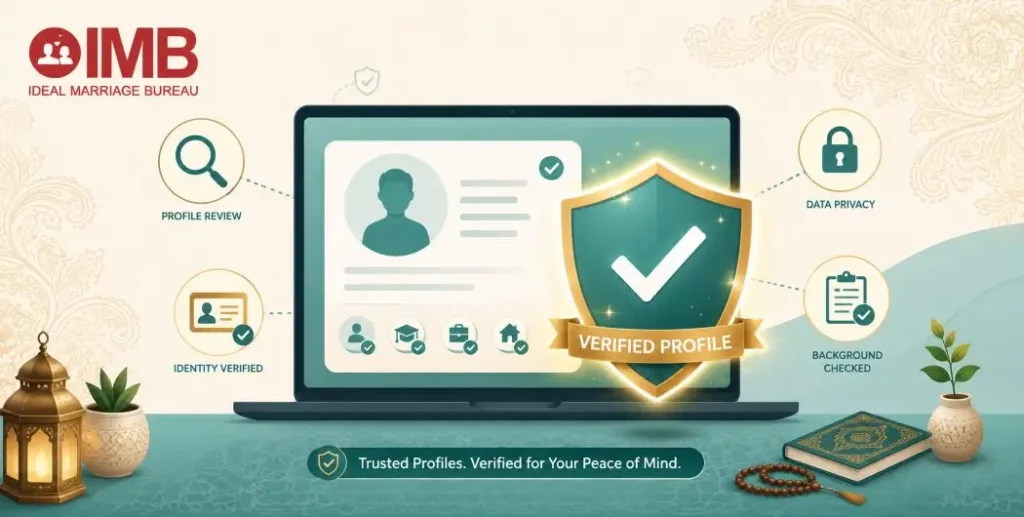
1. The website explains what “verified” actually means
“Verified profile” sounds reassuring. It is also incomplete.
A phone number being verified does not necessarily prove that the person’s education, profession, marital status, address, family background, or other profile information is accurate.
Before trusting a matrimonial website, look for an explanation of its verification process.
Ask:
What information is checked, and how?
A platform that explains its process gives you something concrete to evaluate. A platform that simply puts a verification badge beside every profile gives you much less information.
For a serious rishta search, verification should be treated as one layer of protection, not a replacement for your own due diligence.
How Ideal Marriage Bureau Verifies Every Profile
No fake profiles. No guesswork. See the exact checks every rishta goes through before it ever reaches your family.
2. You can control what strangers see
Privacy is not just about whether a website says it protects your data.
Look at what happens when you create an account.
Can you control who sees your photographs? Can you restrict contact information? Can you remove or deactivate your profile? Is your full name publicly displayed?
These details matter because a matrimonial profile can contain a surprisingly useful collection of personal information: age, city, education, profession, family details, photographs, workplace information and other identifying details.
Pakistan’s National CERT has also highlighted privacy and personal-information risks associated with online matrimonial applications. Its advisory provides practical context for why users should think carefully about the information they publish on matrimonial platforms. Pakistan National CERT advisory on online matrimonial apps
A sensible rule is simple:
Do not publish information on a matrimonial website that you would not want a stranger to have.
3. The platform gives you a proper way to report and block people
Something feels wrong.
The person is rude. They keep asking for private photographs. They pressure you for your phone number. They refuse reasonable questions. They want money.
What happens next?
A safer matrimonial website should make reporting and blocking straightforward. You should not have to hunt through the website to find out how to report suspicious behavior.
This is one of the areas where safety becomes practical rather than promotional.
A platform should have a clear path from:
suspicious behavior → report → review/action
Also look for a customer-support channel that is actually reachable.
4. The website treats communication as part of safety
The first conversation should not require you to hand over your personal phone number immediately.
Secure or controlled communication gives users time to decide whether they are comfortable continuing the conversation.
That matters because scammers frequently try to move conversations away from the original platform. The FTC warns that romance scammers may quickly seek direct communication and later create stories that lead to requests for money.
Moving to WhatsApp is not automatically a scam. Many legitimate Pakistani families use WhatsApp every day.
The warning sign is pressure.
If someone says, “Give me your number now or I will stop talking to you,” slow down.
5. The platform is built around marriage, not endless chatting
A matrimonial website should have a clear purpose.
Serious matchmaking is different from casual social interaction. The objective is eventually to establish whether two people and their families are suitable for marriage.
That does not mean every conversation needs to involve parents from the first message. It does mean the process should have a sensible path toward greater transparency.
For Pakistani families, that can include appropriate family involvement, proposal discussions, verification, and eventually a family-to-family introduction.
Ideal Marriage Bureau describes its matchmaking process around profile creation, proposal matching and meetings after mutual interest. Its website says it has served Pakistani and international profiles since 2010.
From “hello” to “we do”: the rishta process, decoded
Six clear stages. Zero guesswork. See how Ideal Marriage Bureau turns a rishta search into a real match.
6. You can identify who operates the website
Before sharing personal information, look at the organization behind the website.
Is there a real business identity?
Is there a physical address?
Can you contact someone?
Are there terms of use and privacy information?
Does the organization explain how its matchmaking process works?
These checks do not prove that every profile is genuine. They simply give you a better basis for deciding whether the service itself is accountable.
For example, Ideal Marriage Bureau publicly identifies itself, describes its history, provides contact information and explains its matchmaking process.
That kind of transparency is worth looking for when comparing matrimonial services.
7. The website does not promise more than it can prove
Be careful with absolute claims.
“100% genuine.”
“Guaranteed marriage.”
“Perfect match guaranteed.”
“Zero risk.”
No website can guarantee another person’s honesty or predict whether two people will marry successfully.
A responsible matrimonial service can explain its screening, matching and support process. It cannot control what every individual does.
This is where readers should be a little skeptical-even of a website that looks polished.
How do you check whether a matrimonial profile is genuine?
This is the part many articles skip.
A safe matrimonial website reduces risk. It does not complete your investigation for you.
If you are seriously considering a proposal, compare information instead of accepting the profile at face value.
Check whether the person’s:
- Age and education are consistent
- Profession and workplace information make sense
- Marital status is clearly stated
- Location matches what they tell you
- Family information is consistent
- Communication style remains consistent over time
- Answers to reasonable questions make sense
For an important proposal, involve appropriate family members or trusted people rather than keeping the entire process private.
And use independent verification where appropriate.
The FBI recommends researching a person’s photo and profile information online, going slowly, asking questions, and being cautious when someone tries to isolate you from family or asks for financial information.
How to Verify Marriage Proposals Safely
Got a proposal you’re unsure about? Learn the exact red flags to check before you trust a rishta with your family’s future.
What are the biggest red flags on a matrimonial website?
A fake profile does not always look fake.
That is the problem.
Someone may have attractive photographs, a detailed biography and a convincing story. The warning signs can appear later.
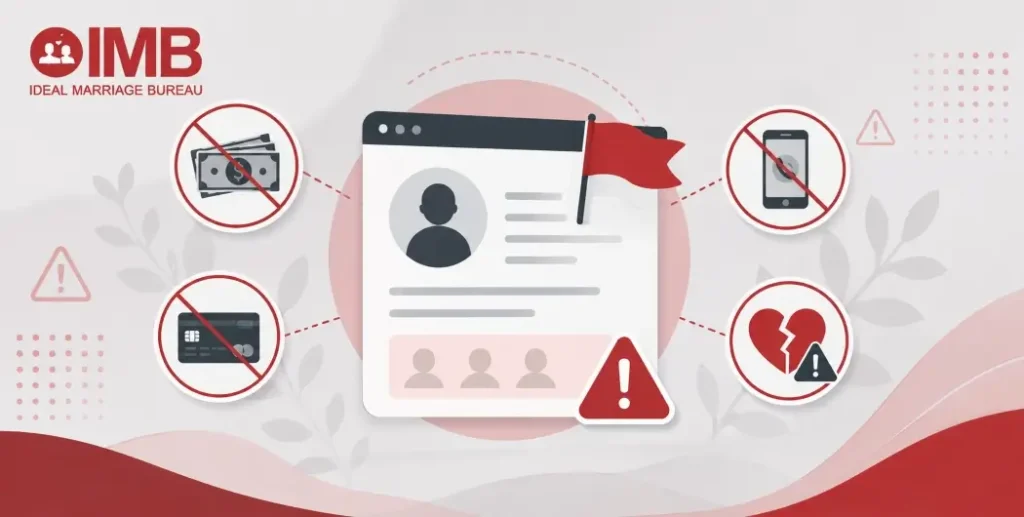
Take extra care if someone:
- Pushes for emotional commitment unusually quickly
- Avoids reasonable questions about their background
- Refuses every opportunity for appropriate verification
- Keeps cancelling plans to meet
- Wants private or compromising photographs
- Pressures you to hide the relationship from family
- Requests money
- Asks to use your bank account
- Claims an urgent medical, travel, legal or financial problem
- Wants you to invest or transfer money for them
The FBI specifically warns that romance scammers can build trust through fake online identities before asking for money. It also warns against allowing someone you met online to use your bank account for transfers.
The FTC gives similar advice: never send money or gifts to someone you have not met in person, and consider a reverse-image search when a profile raises questions.
One rule deserves to be remembered:
A marriage proposal is never a reason to abandon basic financial judgment.
Is it safe to share your phone number on a matrimonial website?
There is no universal rule that you should never share it.
The better question is when you should share it.
Start with the website’s communication tools if they provide them. Once mutual interest is established and you are comfortable, communication can move to another channel.
But don’t share your:
- Bank account details
- OTPs or verification codes
- Passwords
- Debit or credit card information
- Financial documents
- Private photographs
- Sensitive identification documents
unless there is a legitimate, clearly understood reason—and even then, verify who is requesting them and why.
If someone needs your bank account to “receive money,” stop. The FBI specifically identifies this as a potential money-mule warning sign.
How can families use a safe matrimonial website?
Families should treat an online rishta profile as the beginning of verification, not the end of it.
A practical family process is:
Profile → initial questions → basic verification → family contact → further background checking → meeting → decision
The exact order can change depending on the family and circumstances.
What should not change is the principle: don’t make a major decision solely because a profile looks impressive.
Education, profession, photographs and family claims are useful pieces of information. They are not a complete picture of someone’s character.
For families using online matrimonial platforms, this distinction is especially useful because it prevents two opposite mistakes:
Blind trust – “The website verified them, so everything must be true.”
Complete distrust – “Online profiles are never safe.”
Neither approach is sensible.
The better approach is controlled, gradual verification.
Safe matrimonial website checklist
Before registering or starting serious conversations, ask yourself:
- Does the website explain its verification process?
- Can I control profile and photo visibility?
- Can I block or report suspicious users?
- Is customer support easy to reach?
- Does the website clearly identify its operator?
- Are its privacy practices understandable?
- Can I communicate without immediately exposing my personal contact details?
- Does the platform encourage responsible matchmaking rather than rushed decisions?
- Have I checked the person independently before treating the proposal as genuine?
- Have I involved a trusted family member when appropriate?
If several answers are “no,” don’t rush into registration simply because the website has a large number of profiles.
More profiles do not automatically mean more safety.
What should you do if you suspect a matrimonial scam?
Stop.
Do not send money to “prove” your trust. Do not allow someone you met online to use your bank account. Do not send compromising photographs because they promise marriage.
Save relevant messages and profile information, stop communicating if you believe you are being scammed, and report the account to the platform. The FTC and FBI both recommend stopping communication and reporting suspected romance scams.
If money has already been transferred, contact your bank or payment provider promptly and report the fraud through the appropriate authority in your jurisdiction.
FAQs about safe matrimonial websites
What is a safe matrimonial website?
A safe matrimonial website is a platform that uses reasonable verification, privacy controls, secure communication options, reporting tools and customer support to reduce risks associated with online matchmaking.
Are matrimonial websites completely safe?
No website can guarantee that every user is honest. A platform can reduce risk through verification and safety controls, but users should still independently verify important information before accepting a marriage proposal.
How can I identify a fake matrimonial profile?
Look for inconsistencies in age, education, profession, location, family information and communication. Reverse-image searches can also help identify photographs that appear elsewhere under different identities.
Should I send money to someone I met on a matrimonial website?
No. Do not send money to an online romantic interest whom you have not met in person. The FTC specifically recommends against sending money or gifts in these circumstances.
What is more important: profile verification or background verification?
They serve different purposes. Profile verification can establish certain account or identity details, while broader background verification looks at whether important claims made by the person are accurate. Neither should be treated as proof that someone is automatically suitable for marriage.
The safest way to use a matrimonial website
Don’t judge a matrimonial website by its homepage alone.
Look underneath the marketing.
Find out what it verifies. Check its privacy controls. Test whether support is reachable. Understand how reporting works. Then apply the same discipline to the individual profile you are considering.
For Pakistani families, a good online rishta process should gradually move from profile → conversation → verification → family involvement → meeting, rather than jumping straight from an attractive profile to trust.
That is the standard I would use when choosing a safe matrimonial website.
If you are comparing online matrimonial platforms with a professional matchmaking service, the next useful step is to compare and see which process gives your family the level of verification, privacy and human involvement you actually need.
Not sure where to start?
Explore Ideal Marriage Bureau’s matchmaking services and get expert support through every step of the rishta evaluation process – from first introduction to final decision.