
- What Is an Arranged Marriage?
- What Is a Forced Marriage?
- The Real Difference: Consent, Not Custom
- The Grey Zone Nobody Talks About: Soft Coercion
- Consent Isn't Always Black or White
- How Arranged Marriage Looks Around the World
- Arranged Marriage Is Evolving — Fast
- Ready to Find a Match Built on Real Compatibility?
- The Case for Arranged Marriage (Yes, Really)
- Red Flags: When "Arranged" Turns Into "Forced"
- Frequently Asked Questions
- Final Thoughts about Arranged vs Forced Marriage
- Thinking About Marriage the Right Way?
Arranged vs forced marriage is one of the most misunderstood comparisons in modern relationships. Marriage brings enough pressure on its own, and cultural assumptions only add to it — one phrase alone can spark a full-blown argument at family dinners: “arranged marriage.”
People often confuse it with “forced marriage.” The two terms sound similar. They are not the same thing at all. One is a tradition that still works for millions of families today. The other is a human rights violation.
This article breaks down the real difference between arranged vs forced marriage, the grey areas nobody likes to discuss, and where the practice of arranged marriage is actually heading in 2026.
What Is an Arranged Marriage?
An arranged marriage happens when family members, matchmakers, or a trusted community network help find a suitable partner. Parents usually lead the search. They consider values, background, career goals, and family expectations.
Here’s the part people miss: both individuals still choose whether to say yes.
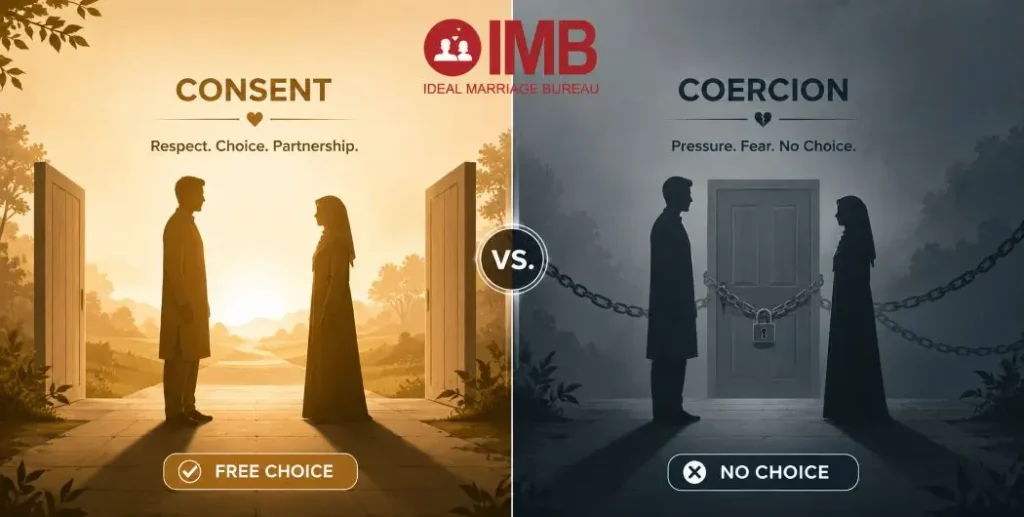
The family opens the door. The couple decides whether to walk through it. Modern matchmaking services, including platforms like our marriage bureau blog, work exactly this way — introducing compatible matches while leaving the final decision to the two people involved.
Nobody drags anyone to the altar. That’s the whole point.
What Is a Forced Marriage?
A forced marriage removes choice from the equation entirely. One or both people never gave full, free consent. Someone used pressure, threats, emotional manipulation, or violence to make the marriage happen.
According to the UK’s Sheffield Hallam University, if a family threatens or hurts someone to make them marry, this crosses into forced marriage and can involve “honour”-based violence.
Forced marriage isn’t a cultural quirk. It’s recognised internationally as a human rights abuse. The International Labour Organization estimated that 22 million people were living in forced marriage worldwide on any given day in 2021, with nearly two-thirds of cases concentrated in Asia and the Pacific. That number rose by 6.6 million between 2016 and 2021 — a trend moving in the wrong direction, not the right one.
The Real Difference: Consent, Not Custom
Here’s the one sentence worth remembering: arranged marriage runs on consent, forced marriage runs on coercion.
That’s it. That’s the whole distinction.
The Tahirih Justice Center puts it plainly: in an arranged marriage, either party can walk away at any point, for any reason — “not at all,” “not now,” or “not to this person.” Nobody loses that right just because a family introduced the match.
Forced marriage removes that exit. Full stop.
The Grey Zone Nobody Talks About: Soft Coercion
Most articles online stop at the consent definition and move on. That’s a mistake, because real families rarely operate in black and white.
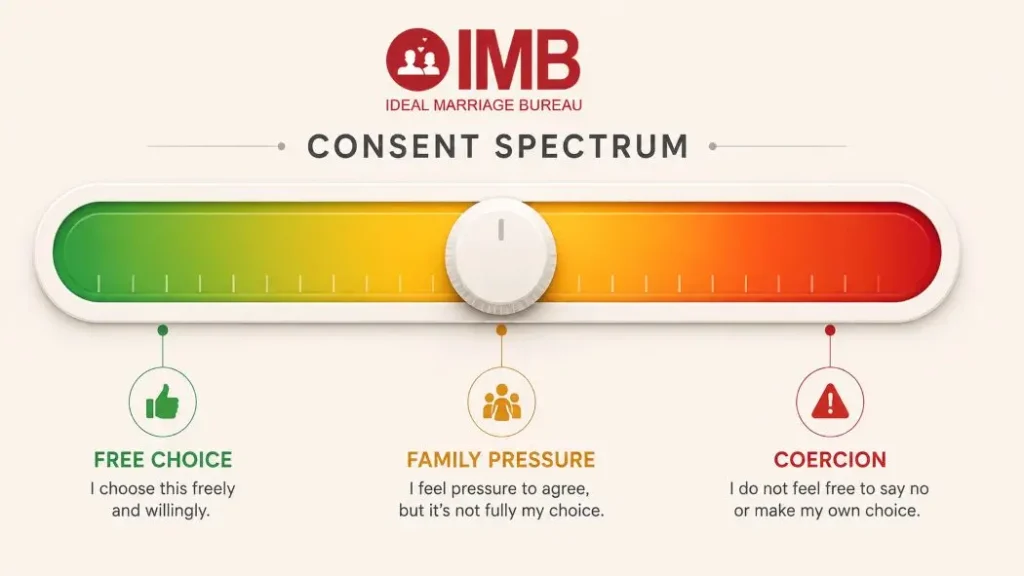
Soft coercion sits in the middle. Nobody threatens violence. Nobody locks a door. Instead, pressure shows up quietly:
- Guilt trips about family honour
- Reminders about how much the parents have sacrificed
- Financial dependency that makes saying no feel impossible
- Repeated rejection of every candidate the person actually likes, until they give up choosing
None of this looks like abuse from the outside. It still removes genuine free choice from the inside.
Unchained At Last, a nonprofit that works directly with forced marriage survivors, raises the exact question worth sitting with: what if someone “consents” only because they were raised believing someone else must choose their spouse? Is that consent, or is it just coercion wearing a nicer outfit?
There’s no easy answer. But asking the question honestly is more useful than pretending the line is always obvious.
Consent Isn’t Always Black or White
Think of consent less like a light switch and more like a dimmer.
On one end: full, informed, pressure-free choice. On the other: outright coercion and threats. Most real situations land somewhere in between, and that middle stretch deserves more attention than a one-line disclaimer.
A few honest markers can help someone figure out where they stand:
- Can you say no to a specific candidate without real consequences?
- Can you say no to marriage entirely, even temporarily?
- Do you get real time to think, or are you rushed into an answer?
- Does anyone threaten your safety, finances, or relationships if you refuse?
If the answers lean toward “no” repeatedly, the situation has drifted away from a genuine arrangement — even if nobody in the family would ever use the word “forced.”
How Arranged Marriage Looks Around the World
Arranged marriage isn’t one single practice. It shifts shape depending on where it’s practiced.
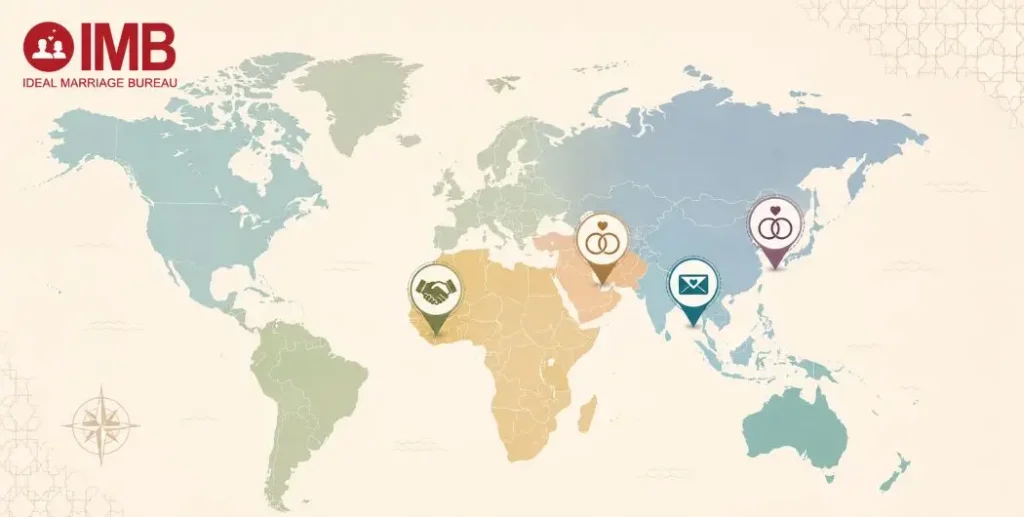
In many South Asian communities, families lead the introduction, but modern couples increasingly get phone numbers, video calls, and months to decide before any commitment. In parts of West Africa, extended family and community elders play matchmaker, with the couple retaining formal veto power. Orthodox Jewish communities often use a shadchan (matchmaker) who proposes matches based on values and lifestyle compatibility, with both sides free to reject a suggestion outright.
Japan’s traditional omiai process works similarly — a formal introduction followed by dates, with either person able to decline before things go further.
The common thread across all of these systems: someone helps with the search, but nobody removes the final decision from the couple. That single detail is what keeps a tradition from becoming a violation.
Arranged Marriage Is Evolving — Fast
The image of arranged marriage as two strangers meeting for the first time at the wedding is largely outdated in most communities today.
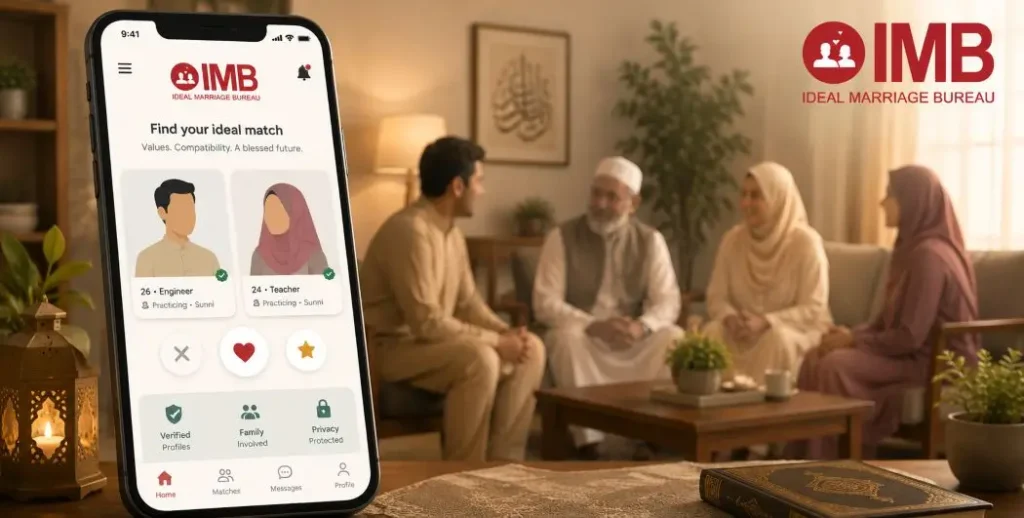
Modern matchmaking has changed shape. Families now use verified matchmaking platforms, structured introductions, and multiple meetings before any decision gets made. Many young adults set their own criteria upfront and simply ask parents or professional matchmakers to filter candidates against it — closer to a curated dating pool than a traditional arrangement.
This shift matters. It shows that “arranged” doesn’t mean “outdated.” It means the process adapts while the core principle — mutual consent — stays exactly where it should be.
Ready to Find a Match Built on Real Compatibility?
If you’re exploring a marriage built on genuine choice, structured introductions, and family support without pressure, browse verified profiles and guidance on Ideal Marriage Bureau to start the process the right way.
The Case for Arranged Marriage (Yes, Really)
Arranged marriage gets an unfair reputation in a lot of Western media. It’s worth making the honest case for it, because the current top search results barely touch this angle.
It removes decision fatigue. Modern dating apps hand people an overwhelming number of choices, which research on choice overload consistently links to lower decision satisfaction. A curated introduction narrows that noise down to people who actually share your values.
Families stay invested in the outcome. When parents help choose a partner, they often stay more involved in supporting the marriage afterward — practically, financially, and emotionally.
Compatibility gets checked upfront. Instead of discovering a values mismatch two years into a relationship, arranged introductions typically address family background, life goals, and expectations before the first date even happens.
None of this makes arranged marriage automatically better than a love marriage. It simply means the format itself isn’t the problem. Coercion is the problem — and coercion can show up in any kind of marriage, arranged or not.
Red Flags: When “Arranged” Turns Into “Forced”
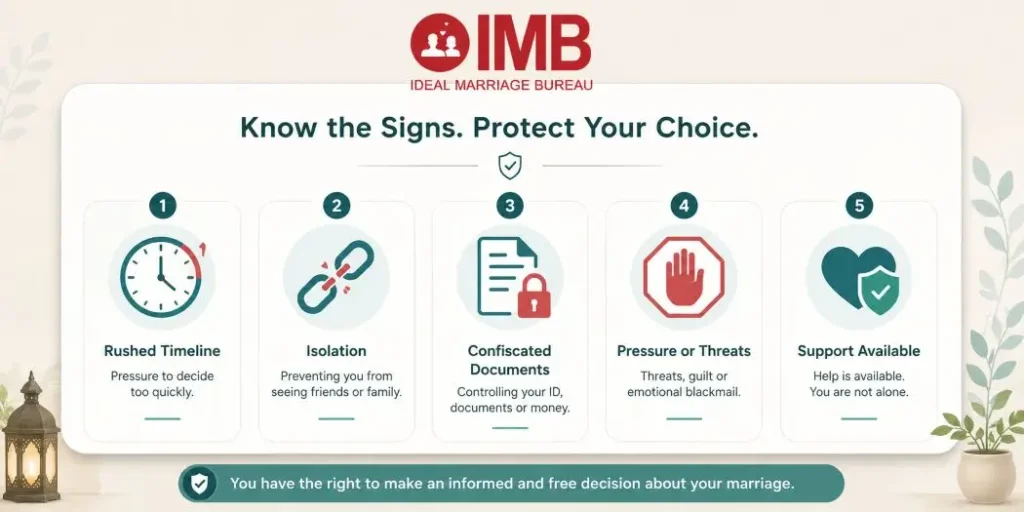
A few warning signs suggest an arrangement has crossed a line worth taking seriously:
- Sudden pressure to marry quickly, with no real time to think
- Threats — physical, financial, or emotional — tied to refusal
- Isolation from friends or a support network during the process
- Confiscation of documents, passports, or access to money
- A pattern of ignoring “no” until the person simply stops saying it
The UK government’s Forced Marriage Unit and organisations like Unchained At Last offer direct, confidential support for anyone facing these situations. Nobody has to handle this alone, and reaching out for help is never an overreaction.
Frequently Asked Questions
Is arranged marriage the same as forced marriage?
No. Arranged marriage involves family-led introductions with full consent from both people. Forced marriage removes that consent through pressure, threats, or coercion.
Can someone reject a proposed match in an arranged marriage?
Yes. In a genuine arranged marriage, either person can decline a specific match or the idea of marriage altogether, without facing real consequences.
What turns an arranged marriage into a forced one?
Pressure escalates. If refusal leads to threats, isolation, financial punishment, or physical harm, the situation has moved from arranged into forced.
How common is forced marriage globally?
The ILO, Walk Free, and IOM estimated 22 million people were living in forced marriage worldwide in 2021, with the number rising over the previous five years.
Where can someone get help if they’re being forced into marriage?
The UK’s Forced Marriage Unit and nonprofits like Unchained At Last and the Tahirih Justice Center offer confidential guidance and support for people facing forced marriage situations.
Final Thoughts about Arranged vs Forced Marriage
Arranged marriage and forced marriage sit on opposite ends of the same conversation. One respects choice. The other erases it.
The healthiest version of arranged marriage looks less like tradition for tradition’s sake and more like a well-run introduction service — families and matchmakers doing the groundwork, while the couple keeps full control of the outcome. That balance is worth protecting, and worth understanding clearly, instead of lumping two very different things under one confusing label.
Thinking About Marriage the Right Way?
A good match starts with respect, not pressure. Explore our detailed guides on family-supported matchmaking to understand exactly how a healthy, consent-first process should work from day one.